
How Red Light Therapy Restores Your Eyes
If you are reading this through tight, dry, or watering eyes while shifting uncomfortably at your desk, you already know the feeling.
By mid-afternoon, your screen feels blindingly bright, a dull ache settles behind your temples, and focusing on simple text becomes a chore. Most desk workers assume this burning, heavy sensation is just the tax we pay for making a living in front of digital displays. You reach for artificial eye drops or try turning down your screen’s brightness, but by 4:00 PM, the strain always returns.
The issue isn’t that your eyes are naturally weak. The problem is a severe biological mismatch: your eyes were designed to thrive under full-spectrum sunlight, but you are forcing them to spend 8 to 10 hours a day staring directly into isolated blue-light screens while sitting under harsh overhead lighting.
Here is the exact biological breakdown of why screen work causes severe eye strain—and how targeted red light technology fixes the root cause right at your workstation.
The Biomechanics of Screen-Driven Eye Strain
To permanently stop ocular fatigue, you first need to understand the physical and cellular stress occurring inside your eyes every time you work on a computer.
1. The Isolated Spectrum Trap and Retinal Oxidative Stress
Standard computer displays and white LED office lights emit intense, narrow-band blue light without the balancing long wavelengths found in nature. While natural sunlight provides a balanced spectrum of visible and invisible light, isolated high-frequency blue light creates reactive oxygen species (ROS) inside your retinal cells. Over an 8-hour workday, this oxidative stress depletes your cellular energy reserves, leaving your eyes feeling raw, exhausted, and inflamed.
2. Ciliary Muscle Micro-Spasms and Focus Locking
Focusing on a flat 2D screen forces the tiny ciliary muscles surrounding your lens to lock into a constant, tense contraction. Because digital pixels lack the physical depth and clear contrast of real-world objects, your eyes are forced to make thousands of subtle micro-adjustments every minute to keep the image sharp. This continuous muscle tension is what triggers that deep, aching pain behind your eyes and leads to tension headaches.
3. The 50% Blink Drop and Tear-Film Collapse
When you stare intently at a computer screen or absorb high-focus documents, your natural blink rate drops by up to 50%. Every time you fail to blink, your cornea loses its protective layer of moisture. The natural tear film evaporates, causing surface friction, microscopic irritation, and that gritty sensation that feels like sand trapped under your eyelids.
4. Disrupted Circadian Rhythms and Cumulative Fatigue
Exposure to unfiltered artificial blue light well into the late afternoon tricking your brain into thinking it is still peak solar noon. This suppresses your natural melatonin production long before your shift ends. Your nervous system remains stuck in a hyper-aroused state, ruining your sleep architecture at night and creating a cycle of chronic daytime exhaustion.
How the Heilys Addred Desk Lamp Solves the Problem
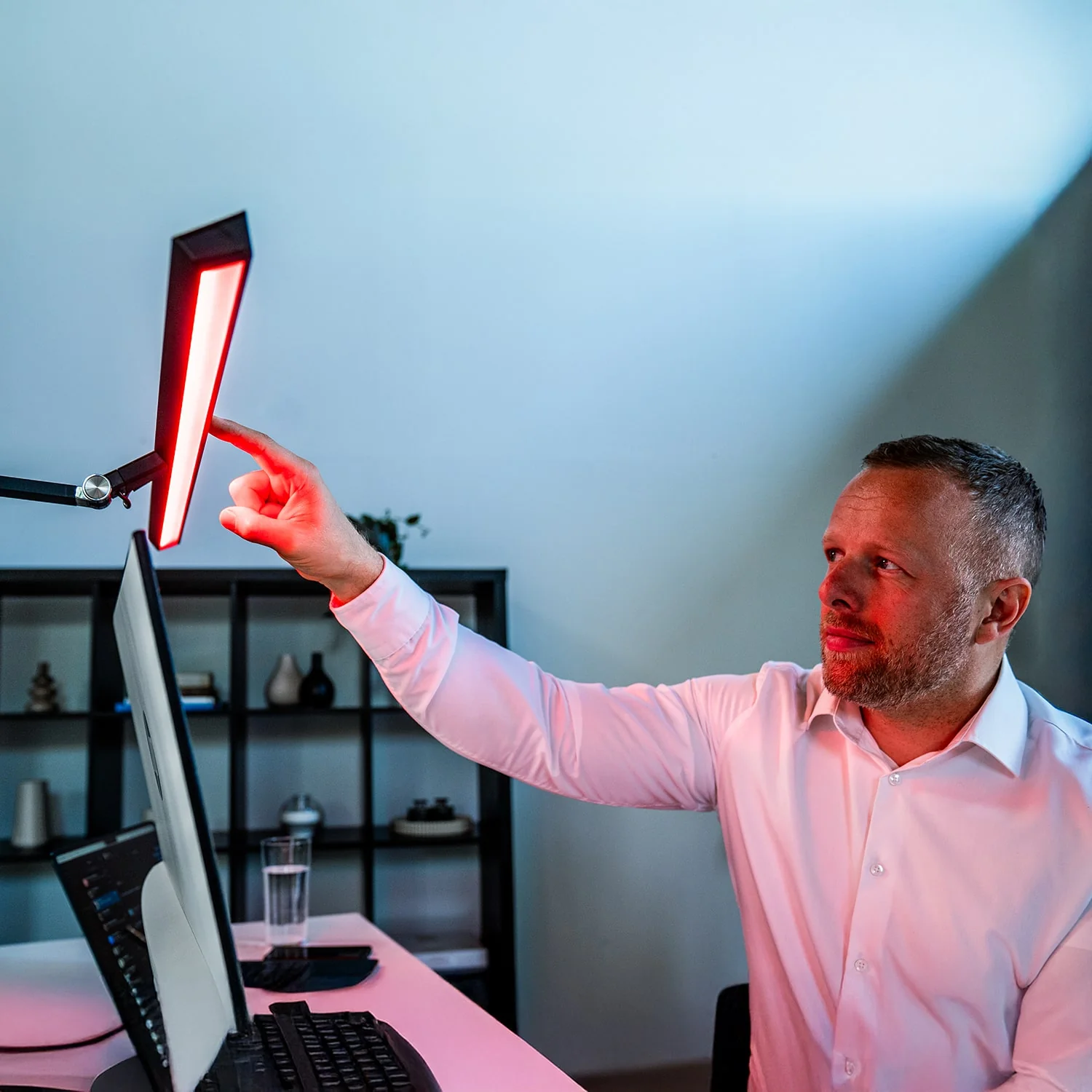
Over-the-counter eye drops only moisten the surface of your cornea for a few minutes, and blue-light blocking glasses merely filter out bad light without providing any active recovery. The Heilys Addred Desk Lamp takes a photobiomodulation (PBM) approach—changing the light environment of your desk to actively restore your eyes while you work.
- 1. Targeted Red Wavelengths for Cellular Repair The Addred lamp bathes your workstation in clinically validated red light wavelengths (660 nm). Absorbed directly by an essential enzyme (cytochrome c oxidase) inside your retinal mitochondria, these red light photons act like a wireless battery charger for your cells. They stimulate adenosine triphosphate (ATP) production, helping repair cellular stress and restoring the energy your eyes need to function without fatigue.
- 2. Ambient Spectrum Balance & Contrast Relief Positioning the Addred desk lamp beside your monitor floods your immediate visual area with warm, restorative light. By softening the stark visual contrast between your bright screen and the surrounding space, it allows your ciliary muscles to relax, preventing the micro-spasms that trigger afternoon headaches.
- 3. Flicker-Free Illumination Built for Focus Cheap LED bulbs and monitors use rapid, invisible pulsing (flicker) to control brightness, which strains your optical nerves behind the scenes. Heilys engineering provides a completely flicker-free, gentle light output designed for long hours of desk work, maintaining eye comfort and steady mental focus through your toughest workdays.
Key Scientific References
- Mitochondrial Photobiomodulation in the Eye: Shinhmar, H., et al. (2020). Optically Improving Mitochondrial Function Reduces Age-Related Retinal Decline. Demonstrates that brief exposure to 670 nm red light recharges ocular mitochondria, significantly boosting ATP synthesis and reducing visual fatigue.
- Blue Light-Induced Ocular Stress: Zhao, Z., et al. (2018). Research Progresses on Damage to Ocular Surface Adaptability by Blue Light. Highlights how isolated blue LED spectra induce oxidative damage in corneal and retinal tissues, confirming the need for restorative long-wavelength light.