
Reversing the Spinal Squeeze
We have all felt it—that heavy, deep, structural ache that settles into your lumbar spine around 2:00 PM. You stretch, you lean back, or you try to stand up, but your lower back feels completely locked, jammed and compressed.
Most office professionals think lower back compression while sitting is just the inevitable tax of working a desk job. As a result, they look for thicker foam seat cushions or aggressive lumbar pads to push their spine back into place.
However, spinal compression isn’t an issue you can simply cushion away. It is a mechanical consequence of physical inactivity and poor bone tracking. Let’s now explore why standard sitting forces your vertebrae to crush your spinal discs, and how introducing dynamic movement actively solves the problem.
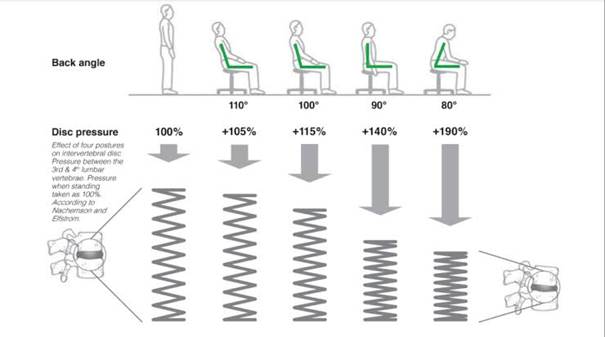
Biomechanical Impact: How sitting increases lumbar disc pressure. Source: Back Care Clinic / How sitting affects disc pressure – Back Care Clinic
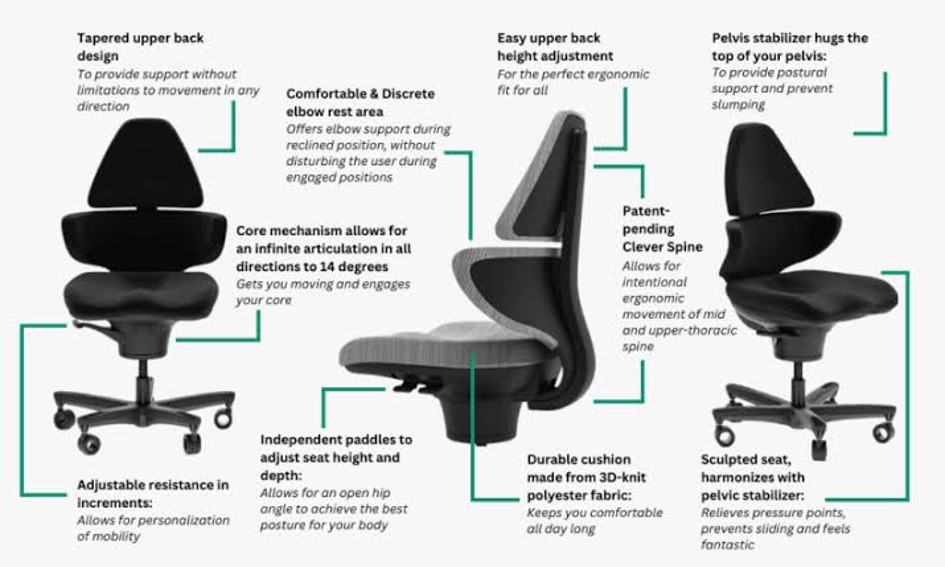
The Solution: CoreChair engineering designed for mechanical unloading. Source: CoreChair
Why Your Body is Hurting
To permanently decompress your lower spine, you first need to understand the physical forces acting on your bones while you sit in a traditional chair.
[Traditional Static Chair] ─> Pelvis Rolls Backward ─> Flattened Lumbar Curve
▼
Gravitational Load Clamps Down Unchecked
▼
Fluid Squeezed Out of Discs ─> Joint Compression & Nerve Pain
When you transition from standing to static sitting on a conventional seat, your body undergoes three major mechanical failures:
1. The 40% Pressure Jump (The Nachemson Factor)
In the 1970s, pioneering researcher Dr. Alf Nachemson measured the exact pressure inside human lumbar discs during different daily tasks. His findings remain the gold standard of spinal biomechanics: sitting unsupported increases the load on your lower back discs by up to 40% compared to standing.
When you lean forward or slump over your keyboard, that internal pressure spikes by an astonishing 90%. A traditional chair traps your body in these exact hunched, high-pressure profiles for hours at a time.
2. The Posterior Slump and Disc Bulge Mechanics
Traditional office chairs feature flat or soft, unsculpted seats. Thus without mechanical boundaries, your pelvis naturally rolls backward into a posterior pelvic tilt.
As your hip bone tucks under, it completely wipes out the natural forward curve (lordosis) of your lower spine. This then shifts your vertebrae into a wedge shape, compressing the front edges of your spinal discs and forcing the gel-like nucleus inside them to push backward against your sensitive nerve walls.
3. Dehydration of the Intervertebral Shock Absorbers
Your spinal discs are dynamic, fluid-filled pads acting as shock absorbers. Because they lack a direct blood supply, they stay healthy through imbibition—a process where physical movement acts as a manual pump, drawing in fresh water and nutrients while flushing out inflammatory waste.
When you sit completely still in a standard chair, the pump turns off. Gravity steadily squeezes fluid out of the discs without allowing them to rehydrate. Because they lose volume, your joints begin to grate together, causing deep, bone-on-bone ache and muscle spasms.
How CoreChair Actively Decompresses Your Spine
Traditional ergonomic chairs try to solve this by creating a highly rigid, locked-in posture cage. But locking a compressed spine into a new static shape doesn’t restore the spinal pump.
CoreChair solves lower back compression by using a patented 3D fluid pivot mechanism to mechanically decompress your joints while you work.
[Anatomical Seat Pocket] ─> Locks pelvis in place, eliminating the slump
▼
[Patented 3D Fluid Pivot] ─> 14-degree movement mimics natural walking
▼
[Active Imbibition Pump] ─> Draws fluid back into compressed spinal discs
1. Re-establishing the Natural Lumbar Curve
The CoreChair doesn’t use a massive backrest to push your spine forward. Instead, it features an anatomically sculpted seat pocket paired with a low pelvic stabilizer. By bracing the base of your pelvis (the sacrum), it physically blocks your hip bones from rolling backward. Because your pelvic base is held perfectly level, your lumbar spine naturally stacks itself into an ideal curve, immediately neutralizing the uneven pinching forces on your lower discs.
2. Re-igniting the Fluid Imbibition Pump
Directly beneath the CoreChair seat is a specialized pivot engine that allows for up to 14 degrees of controlled, multi-directional motion.
As you type, reach and shift, the seat oscillates subtly with your centre of gravity. This ongoing movement removes the static load from your spine. The micro-movements recreate the natural pumping action of walking, drawing fresh fluid back into your compressed lumbar discs to restore their thickness and relieve joint pressure.
3. Activating Muscle Stability to Defend Against Gravity
Because the CoreChair responds dynamically to your weight distribution, it gently challenges your deep stabilizing core muscles (transversus abdominis and multifidus). Instead of your skeleton collapsing under the weight of gravity while your muscles sleep, your core stays lightly engaged. This muscle activation shares the load, taking the heavy pressure off your lower vertebrae and keeping your spine energized all day.
Scientific Data & Research References
The movement principles built into the CoreChair are fully supported by peer-reviewed research in spinal safety and clinical biomechanics:
- Disc Pressure Dynamics: Dr. Alf Nachemson’s foundational research (Spine, 1976) conclusively showed that sitting postures radically increase intradiscal pressure compared to standing, establishing the core need for functional pelvic support.
- Dynamic Seating and Tissue Hydration: Studies published in the Journal of Spinal Disorders & Techniques prove that continuous, low-intensity movement while seated significantly boosts fluid exchange (imbibition) in lumbar discs, helping reduce the structural height loss linked to static sitting.
- Core Recruitment Verification: Quantitative testing by the University of Waterloo confirmed that CoreChair’s multi-directional pivot increases core muscle involvement and raises metabolic output by up to 17% compared to traditional static office chairs, avoiding the muscle fatigue that triggers postural collapse.
Ready to unlock your spine?
Stop letting your chair squeeze the life out of your lower back. Bring natural, healing movement back to your desk.