
The Science Behind the Chair
If you finish your workday feeling physically spent—despite doing nothing more strenuous than typing and attending virtual meetings—your office chair is likely the culprit.
Many professionals notice that their core feels completely weak and unengaged after a few hours at a desk. You try to sit up straight, but within minutes, your body collapses back into a familiar, sub-optimal slump.
The immediate instinct is to look for a chair with more wrap-around mesh padding or a bigger headrest to hold you up. However, relying on furniture to hold your body structure together is exactly why your deep muscles are failing. Your body is suffering from passive desk atrophy.
Let’s look at the biomechanics of why traditional seating switches off your internal stabilizing network, and how a core-activating office chair like the CoreChair reverses the damage.
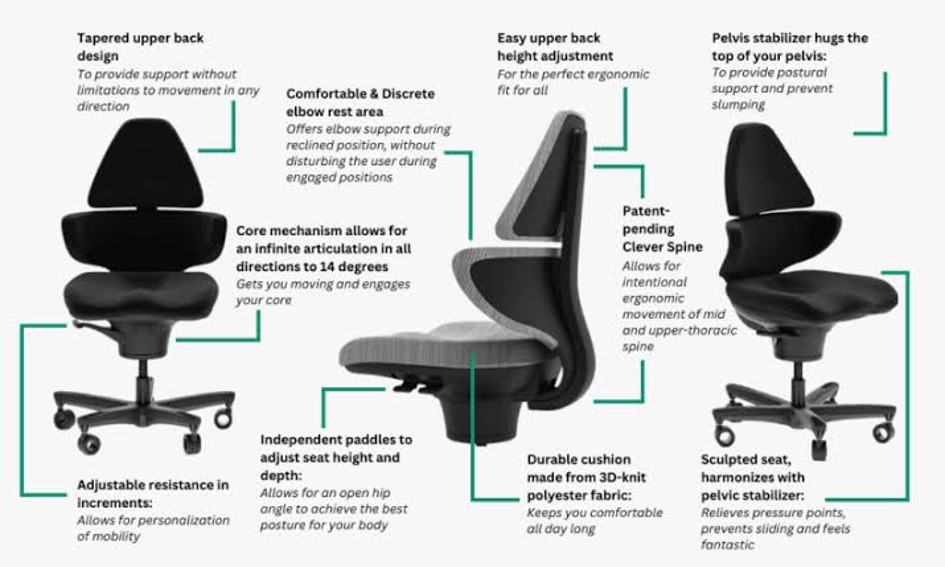
The Dynamic Slump: Muscle shutdown in traditional office chairs. Source: CoreChair
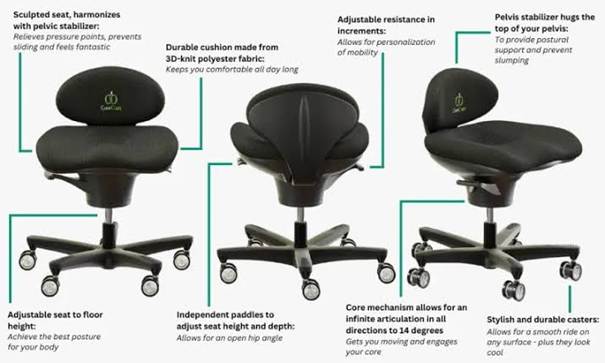
The Core CoreChair Engine: Designed for low-intensity active sitting. Source: CoreChair
Why Your Core is Dormant and Your Body Hurts
To understand why a traditional ergonomic chair leaves your midsection feeling weak and your lower back aching, you have to look at the relationship between passive spinal bracing and muscular health.
[Traditional Locked High-Back Chair]
▼
Complete Passive Bracing
▼
Neurological Shutdown of Core Stabilizers (Transversus Abdominis & Multifidus)
▼
Skeletal Collapse ─> High Intradiscal Pressure ─> Chronic Lumbar Fatigue
When you spend your day pinned against a standard office chair, three distinct physiological failures take place:
1. Neurological Disengagement (Sensory-Motor Amnesia)
Your deep core—specifically the transversus abdominis (the internal corset wrapped around your midsection) and the multifidus (the small stabilizing muscles running along your vertebrae)—is hardwired to respond to balance changes.
When you sit in a highly supportive, locked-in office chair, the furniture handles all the stabilization work for you. Your nervous system recognizes this lack of demand and down-regulates muscle firing. Over an 8-hour workday, your core muscles effectively go to sleep.
2. The Structural Mechanics of the Skeletal Collapse
Without your deep core stabilizers actively working to hold your spine upright, gravity bears down entirely on your bones. As your torso tires out, your pelvis naturally rolls backward into a posterior pelvic tilt.
This pelvic drop flattens the natural, shock-absorbing inward curve of your lower back, changing it into a rigid, hunched C-shape. In this posture, your lower vertebrae act like a wedge, squeezing the front edges of your spinal discs and pushing the gel-like nucleus inside them backward toward sensitive nerve endings.
3. Reduced Metabolic Rate and Static Tissue Ischemia
When your trunk muscles are turned off, the internal “skeletal pump” stops working. This leads to ischemia (restricted blood flow and oxygenation) within your lower back tissues.
At the same time, keeping large stabilizing muscle groups completely still drops your hourly metabolic output to a crawl. This lack of circulation causes metabolic waste products to accumulate in your tissues, resulting in that deep, burning lower back fatigue by mid-afternoon.
The CoreChair Dynamic Pivot Solution
An office chair built to engage your core shouldn’t force you to balance precariously on a giant fitness ball, nor should it lock you into a rigid posture cage.
The CoreChair addresses this by combining mechanical pelvic stabilization with a patented 3D fluid pivot mechanism that prompts low-level, continuous core use while you work.
[Anatomical Pelvic Stabilizer] ─> Locks Sacrum into Neutral Alignment
▼
[Patented 3D Fluid Pivot] ─> 14° Micro-Movements Ignite Trunk Stabilizers ─> Continuous Passive Blood Flow & Postural Strength
1. Stabilizing the Sacrum to Build a Strong Foundation
The CoreChair completely moves away from the massive, rigid backrest design. Instead, it uses an anatomically sculpted seat pocket paired with a low pelvic support pad. This pad fits securely against your sacrum (the bone structure at the base of your spine).
By physically blocking your pelvis from dropping backward into a posterior slump, the CoreChair naturally stacks your spine into perfect, self-supported alignment. You don’t need a high backrest because your skeletal foundation is perfectly level.
2. The 3D Fluid Pivot: An Ongoing Core Workout
Directly beneath the CoreChair’s seat is a patented dynamic motion engine that allows for up to 14 degrees of controlled articulation in all directions.
As you reach for your mouse, turn to speak with a colleague, or simply shift your weight, the seat shifts smoothly with you. This slight instability requires your transversus abdominis and multifidus muscles to subtly, subconsciously fire to maintain balance. It acts like a low-intensity workout for your core, keeping your stabilizing muscles awake, strong, and highly responsive throughout the day.
3. Re-Igniting Circulation and Boosting Energy
Because your trunk muscles remain lightly engaged, your body’s circulation continues to flow freely. Every micro-movement on the CoreChair helps pump oxygenated blood through your deep tissues, flushing out inflammatory waste and preventing joint freezing. This steady muscle engagement increases daily calorie burn and keeps you feeling physically energized and mentally sharp all afternoon long.
Scientific Data & Research References
The shift from passive, high-backed seating to dynamic core activation is backed by peer-reviewed studies in biomechanics and occupational health:
- Core Muscle Deactivation: Clinical research published in Ergonomics confirms that high-backed office seating with rigid lumbar supports reduces stabilizing muscle activity in the trunk, directly contributing to long-term core weakness.
- Core Activation and Caloric Expenditure: Comprehensive movement testing conducted at the University of Waterloo demonstrated that sitting on a CoreChair increases core muscle recruitment and elevates metabolic demand by up to 17% compared to traditional static chairs.
- Dynamic Postural Benefits: A study in The Spine Journal shows that dynamic seating options allow for ongoing variations in pelvic tilt, preventing the disc compression and fluid volume loss linked to sitting completely still.
The Verdict:
Don’t Let Your Chair Do Your Body’s Work
- Standard Ergonomic Chairs act like a structural brace, letting your core stabilizers weaken while leaving your spine vulnerable to gravity.
- The CoreChair Active Seating Stool acts like a balance trainer, stabilizing your pelvis while prompting the healthy, active movement your core needs to stay strong and pain-free.