
Active Sitting Chair vs. Traditional Lumbar Support
Walk into any corporate office, and you will see the same thing: premium office chairs equipped with aggressive plastic dial-wheels, mesh curve extenders, or external memory foam pillows. We have been conditioned to believe that traditional lumbar support is the holy grail of back pain prevention.
Yet, despite these highly advanced, locked-in posture cages, workspace back pain, sciatica, and muscle fatigue are at an all-time high.
If you are currently relying on a hard plastic cushion to push your spine into alignment, you are fighting a losing biological battle. The human skeletal system wasn’t designed to be propped up like a building; it was built to find equilibrium through movement.
Let’s dive into the anatomy of why passive lumbar supports ultimately fail your body, and how an active sitting chair like the CoreChair rewrites the rules of ergonomic health.
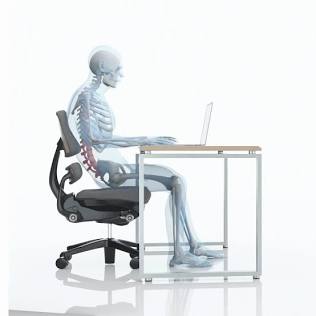
The Failure Mode: How passive lumbar support allows pelvic collapse. Source: Anthros Chair / Pain In The Lumbar Spine? Investigate Your Office Chair!
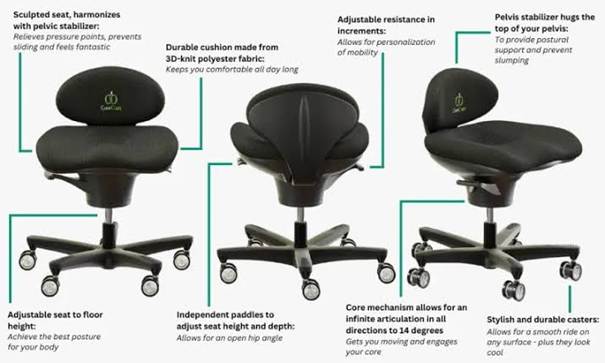
The Dynamic Pivot: CoreChair’s biomechanical blueprint. Source: CoreChair
Why The Traditional Lumbar Support Paradigm Hurts You
To understand why traditional lumbar support feels good for the first ten minutes but leaves you aching by 3:00 PM, we have to look at how a static chair interacts with your musculoskeletal system.
[Traditional Lumbar Pad] ─> Pushes Upper Spine Forward ─> Pelvis Resists & Rolls Backward ─> Spine Flexes Into Opposing Forces ─> Muscle Atrophy ─> Chronic Lumbar Stiffness
When you rely on a passive lumbar support system, three distinct biological dysfunctions occur:
1. Pushing the Spine while the Foundation Collapses
The fundamental flaw of traditional lumbar support is that it attempts to fix your posture by pushing directly on the lumbar vertebrae (L1 ─ L5). However, the shape of your spine is entirely dictated by the angle of your pelvis.
Because traditional chairs feature flat, soft cushions, your pelvis naturally rolls backward into a posterior pelvic tilt. When your pelvis rolls backward, your upper lower back wants to curve backward with it. By forcing a rigid plastic lumbar pad into the mix, you create opposing structural forces: the pad pushes your lower spine forward while your heavy pelvis drags the base backward. This creates extreme mechanical shear stress across your lowest spinal segments (L4 ─ L5 and L5 ─ S1).
2. The Trap of Muscular Splinting and Atrophy
Your body operates on a strict “use it or lose it” neurological protocol. When you lean heavily back against a traditional high-back ergonomic chair, the deep stabilizing muscles of your trunk—specifically the multifidus and internal obliquus—completely stop firing.
The chair essentially becomes a muscular crutch. Over weeks and months, these stabilizing muscles undergo micro-atrophy, growing weaker and less capable of holding you upright. When you finally stand up, your exhausted, unsupported spine feels completely vulnerable, tight, and prone to sudden spasms.
3. Static Ischemia and Intradiscal Dehydration
Sustained pressure against a single point on your back blocks local micro-circulation. This creates a state of ischemia (restricted blood supply) in the deep tissues flanking your spine.
Simultaneously, because you are trapped in a single, locked position, your intervertebral discs are denied the mechanical pumping action (imbibition) they require to absorb fluid and shed cell waste. The result? Your shock-absorbing discs compress, thin out, and become increasingly susceptible to bulges and nerve pinching.
How CoreChair’s Dynamic Pivot Actively Heals Your Spine
An active sitting chair doesn’t try to force your spine into a pre-moulded shape. Instead, it stabilizes the pelvis to allow your spine to align itself, and introduces continuous micro-movement to keep your tissue alive.
[Sculpted Pelvic Stabilization] ─> Safely anchors the Sacral Base
▼
[Patented 3D Fluid Pivot] ─> Delivers 14° of continuous movement
▼
[Neuromuscular Re-education] ─> Constantly wakes up core stabilizers
1. Shifting the Focus from Lumbar to Sacral Stabilization
The CoreChair completely eliminates the giant, intrusive backrest. Instead, it features an anatomically sculpted seat pocket paired with a low, supportive pelvic pad that fits snugly against your sacrum (the structural base of your pelvis).
By physically blocking the pelvis from rolling backward into a posterior tilt, the CoreChair naturally stacks your entire vertebral column into its ideal, inward-curving position. You don’t need a massive plastic pad pushing into your spine because your skeletal foundation is perfectly level.
2. The 3D Fluid Pivot: A Continuous Spinal Pump
Directly underneath the CoreChair’s seat is a patented fluid motion engine that permits up to 14 degrees of controlled articulation in all directions.
As you go about your workday—typing, reaching, and moving—the seat follows your body’s natural shifting weight. This completely destroys static loading. Every micro-movement stimulates the internal spinal pump, driving oxygen-rich fluids back into your compressed discs, flushing away inflammatory markers, and keeping your lower back fluid and pain-free.
3. Gentle Neuromuscular Re-Education
Sitting on a CoreChair acts like a subtle, low-intensity training program for your posture. Because the chair responds smoothly to your centre of gravity, your deep core stabilizers stay mildly active throughout the day to maintain balance. This constant, low-level muscle activation keeps blood circulating freely, builds core stamina, and prevents the painful muscle locking that turns standard desk days into physical endurance tests.
Scientific Data & Research References
The shift from passive lumbar support to dynamic active sitting is validated by peer-reviewed studies in spinal biomechanics and occupational ergonomics:
- Muscle Atrophy in Static Seating: Research published in Clinical Biomechanics demonstrates that high-backed, highly supportive office chairs lead to significant reductions in core muscle activation, accelerating the development of chronic lower back weakness.
- Dynamic Pumping and Fluid Exchange: A foundational study in Spine details that continuous passive motion and active micro-movements of the pelvis maximize fluid transport (imbibition) inside lumbar discs, helping to counteract the compression and volume loss caused by long office shifts.
- Core Activation and Caloric Expenditure: Comprehensive testing conducted by the University of Waterloo verified that CoreChair’s multi-directional pivot increases global stabilizing muscle engagement and boosts metabolic demand by up to 17% compared to traditional static office seating.
The Verdict:
Don’t Prop Up Your Posture.
Activate It.
- Traditional Lumbar Support treats your body like a static statue, pushing against your bones while allowing your deep stabilizing muscles to waste away.
- The CoreChair Active Sitting Chair fixes the root problem by locking your pelvic foundation in place and inviting the healthy, natural fluid movement your joints need to thrive.